
Tag: budget

  • How to Talk to Your Kids About Money

    How to Talk to Your Kids About Money

    When is the best time to talk to your kids about money? Right now! Your kids will learn about money from someone. Don’t let it be from an out-of-control celebrity on social media. You have the opportunity to be the positive example in their lives and the guiding voice they can trust. No, money isn’t a taboo subject, and no, your kids don’t need to be sheltered from financial matters. So buckle up and just have the talk already—or go deeper if you’ve only skimmed the surface. If you want to change your family tree, you’ve got to change your mind-set. Here are five tips on how to talk to your kids about money.

    1. Start slow.

    According to a 2017 T. Rowe Price survey, 69% of parents have some reluctance when it comes to talking about money with their children. And only 23% of kids say they talk with their parents frequently about money. There’s no need to schedule a five-hour lecture presentation to review bank account balances and retirement plan contributions. Start by simply answering your kids’ money questions at an age-appropriate level. You may be surprised at what they already know or what they need to know more about. Once they realize you’re open to these discussions, they may be more comfortable coming to you with money questions.

    1. Be honest.

    If you regret going into debt or not saving more for college, tell your kids. Parents so rarely have open, honest moments with their children. Kids can handle it—really. Instead of hiding your financial failures or covering it up when money is tight, tell your kids the truth. If you ran up debts in your past and had difficulty paying them back, share that. They’ll appreciate your openness and learn a valuable lesson about overspending.

    1. Talk values, not figures.

    If you’re hesitant about disclosing your salary and major expenses to your kids, don’t sweat it. The good news is your kids don’t really want (or need) to know that stuff. They need concepts like savingbudgetingpaying down debt, and giving. To help your kids get an idea of what real-world budgeting looks like, encourage them (when age-appropriate) to download a budgeting/money tracking app. They can use the tool to track spending habits and see just how far their money is going. Soon, establishing a budget will feel like second nature. And if they stick with it, they’ll be well ahead of the curve by the time they hit the college campus.

    1. Set family goals.

    Let your children sit in on and contribute to family budget committee meetings. Just remember you and your spouse are the adults. Only mom and dad make the final decisions. If you are paying off debt or saving for the future, let the kids join in as you celebrate reaching milestones along the way. As you set goals as a family, remind your kids that goals require sacrifice. That might mean skipping a vacation in order to cash-flow a car. But they’ll catch on, especially if they understand these sacrifices will affect their future as well.

    1. Learn about money together.

    Eventually you’ll touch on topics you may not completely ‘get’ yourself; like tax free savings accounts or RRSP’s. If you don’t feel fully knowledgeable on these topics, that’s okay! Admit you don’t have all the answers and do the research together to find ways of securing your future. It’s a great excuse to spend some time together. So go ahead and open up about the family finances, but keep it simple. Start the conversation, be honest, and teach and lead by example. Someday, your money-smart kids will be proud to follow in your big financial footsteps.

    Want more great tips on how to talk to your kids about money? Dave Ramsey and his daughter Rachel Cruze cover this and more in their best seller Smart Money Smart Kids!


  • Budget Your Way to Your Financial Goals

    Budget Your Way to Your Financial Goals

    Budgeting really isn’t that bad. Here are six easy steps to achieving your financial dreams. With a new year just over the horizon, it’s time to make a few resolutions. If you haven’t yet crafted a budget, now is the time to do so for 2018.

    Regardless of whether you want to take a trip to Hawaii, buy a fancy new set of wheels or simply save more and spend less, a budget can get you there. Following are six steps to budgeting to your financial goals.

    Step 1: Set Your Goal

    What do you want to save your money for?

    • Go on a vacation
    • Buy a house
    • Have a security blanket in the bank
    • Merely pay the bills each month, with a little left over

    Budgeting can help with every one of these goals. In addition, having a concrete goal increases your chances of sticking to the budget. Some people even look for motivation by creating dream or vision boards with photos representing their goal.

    Step 2: Track Your Expenses

    Getting a handle on where you spend money is important for two reasons:

    • It can help identify leaks in your budget. These might include the $100 a month gobbled up by daily fast-food breakfasts.
    • It can help you make a realistic budget. If you are currently spending $800 a month on groceries, budgeting for $500 is probably setting yourself up for failure.

    The old-fashioned way to track expenses is to collect receipts and keep a log of every penny you spend for the next month. However, you can make the process simpler by signing up for a free account with Mint.com. This service tracks expenses automatically and neatly categorizes them for you. Best of all, it doesn’t cost a dime.

    Step 3: Write it Down

    Now that you’ve tracked expenses, use those amounts as a guide to create a written budget. Whether you use an online tool, an Excel spreadsheet or a notebook and pen is up to you. But you want to have the budget recorded in a location where it can be easily accessed and changed as needed.

    It’s a good idea to always estimate your income low and expenses high. It’s better to reach the end of the month and find you have extra money in the bank than to come up short. In addition, make sure to put a name to every dollar. Maybe you finish with the monthly bills and have $200 left over. Don’t leave that as a catch-all slush fund; decide what you’re going to do with it. Maybe $100 will go into an online savings account, $50 will be an extra debt payment and $50 will be mad money.

    Step 4: Monitor Your Progress

    Once you have it written down, don’t ignore your budget. Make a point of comparing your actual expenses with your budget on a regular basis, such as each payday.

    If you’re using Mint.com, it’ll be easy to quickly see how much you’ve spent so far in each category for the month. Then, you can make adjustments as necessary. For example, if you’re budgeting $50 for clothing and have spent $75, you’ll need not only to stop buying clothes, but also to make an adjustment elsewhere in your budget to make up for the extra $25.

    On the flip side, maybe it’s the last week of the month, and you haven’t spent a dime of your entertainment budget. In that case, it’s time to make a date and have some fun!

    Step 5: Get a Coach

    Maybe you’re feeling overwhelmed. A budgeting coach can help. Make sure to do your homework and find a reputable company to work with and ask about any fees. You should be able to get budgeting help for free.

    As an alternative, you can ask a money-savvy friend for help. In either case, having someone walk with you step-by-step through the budgeting process can help you make more sense of how to create a realistic spending plan for your money.

    Step 6: Stay Flexible

    Finally, your budget is a living document. Unlike your slow cooker, you shouldn’t set it and forget it. Instead, regularly evaluate it and make changes as necessary. Always blowing through the food budget? You may need to increase it and consider where else you can cut back. In addition, as your income, expenses or goals change, your budget should be adjusted to reflect your new circumstances.

    Ultimately, your budget is not about restricting money, it’s about empowering it. A good budget finally puts you in control of your dollars and allows you to dictate where money is going instead of letting silly, incidental purchases drain your bank account.


  • How to Create a Budget

    How to Create a Budget

    A budget is a plan, an outline of your future income and expenses that you can use as a guideline for spending and saving. Only 47% of Canadians use a budget to plan their spending. But Canadians are feeling more in debt than ever with 90% saying they have more debt today than five years ago. A budget can help you pay your bills on time, cover unexpected emergencies, and reach your financial goals — now and in the future. Most of the information you need is already at your fingertips and the guidelines below will show you how to create a budget.

    Setting Up a Monthly Budget

    It’s a good exercise to document your own actual spending habits for a month or two, and then compare them to this model. This can be a quick way to find out if you are overspending in certain areas.

    STEP 1: Calculate Your Income
    To set a monthly budget, you need to determine how much income you have. Make sure you include all sources of income such as salaries, interest, pension, and any other income sources, including a spouse’s income if you’re married. Determine your pay after deductions, and then use the following chart to help figure out what your monthly take-home pay is:

    • Weekly cheques, multiply by 4.333
    • Every-two-week cheques, multiply by 2.167
    • Twice-a-month cheques, multiply by 2
    • Irregular annual income, divide the net total by 12

    You also want to make sure you add in other sources of income, such as interest income, spousal support, child support, tenant rent, and other payments. As with your pay cheques, determine a monthly average for these streams. Using the downloadable Budget Worksheet, write a dollar figure next to each relevant income source. Make sure that the figure you write down is the amount you receive from each income source on a monthly basis.

    STEP 2: Estimate Your Expenses
    The best way to do this is to keep track of how much you spend each month. The first step is to sum up just where (and how much) you think you are spending. The Expense Worksheet divides spending into fixed and flexible expenses. If some of your expenses for one or more category change significantly each month, take a three-month average for your total. As for the other categories, you might prefer to split them into more narrow subgroups separating food, clothing, and entertainment, for example.

    STEP 3: Figure Out the Difference
    Once you’ve totalled up your monthly income and your monthly expenses, subtract the expense total from the income total to get the difference. A positive number indicates that you’re spending less than you earn – congratulations! A negative number indicates that your expenses are greater than your income and gives you an idea of where you need to trim expenses and by how much.

    Well done! You’ve created a budget. The next step is to make adjustments to this outline in order to achieve your financial goals. Track your budget over time to make sure you’re on track. You need to start making records of your actual income and expenses. This information will help you to understand any “budget variances” – the difference between the amount you planned to spend in a certain category, and the amount you actually spent. Prepare to be surprised for the first couple of months. You may not need to track your spending indefinitely. Usually, a couple of months are all you need to get an idea of where your money is going.

    Helpful Tip

    The 50/20/30 Rule
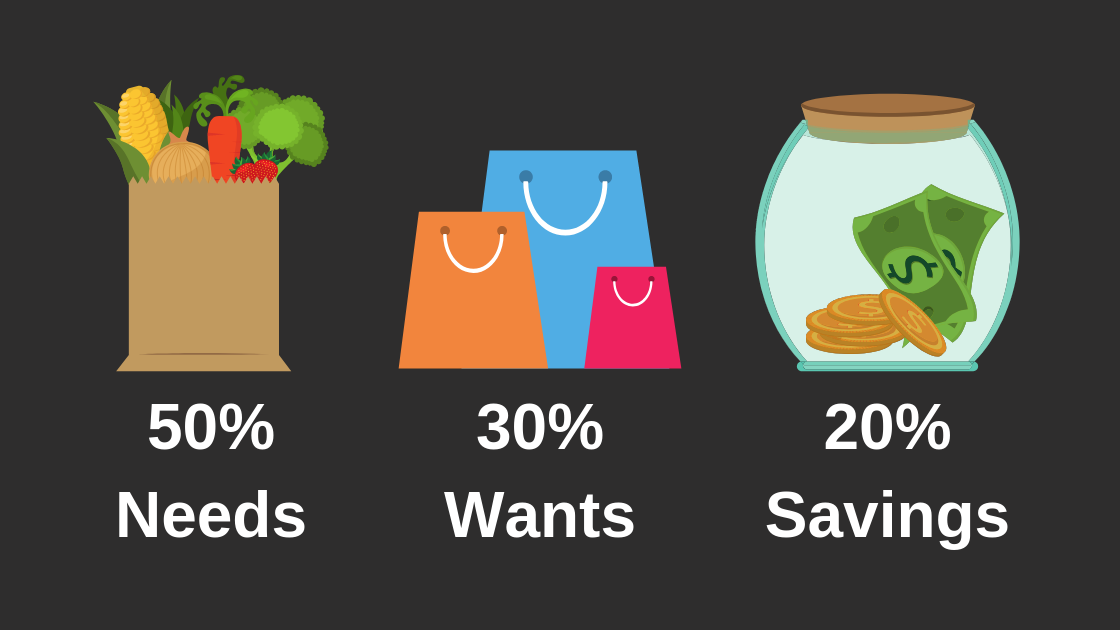
    When creating a budget, you can list each and every monthly expense you incur as its own line item, or you can combine some of your expenses and follow what’s known as the 50/20/30 rule. The benefit of the 50/20/30 rule is that it groups certain expenses together to make your budget easier to track. The 50/20/30 rule splits your living expenses into three main categories:

    1. Fixed costs that stay the same month after month, such as your mortgage, car payment, and cable bill, should take up 50% of your income.
    2. Variable costs that can change from month to month, such as entertainment, groceries, and clothing, should take up 30% of your income.
    3. Savings, which should take up 20% of your income.

    The 50/20/30 rule allows you to retain some flexibility in your budget while saving a nice percentage of your income. While you can always adjust these percentages to accommodate your circumstances, limiting your fixed costs to 50% of your income should leave you with enough money left over to save and cover your variable expenses. Along these lines, allocating 30% of your income to variable costs means you’ll have a decent amount of wiggle room within that category alone.

  • How to Budget for the New Year

    How to Budget for the New Year

    New Year’s resolutions come and go. A sad and small amount often work out like you’d planned and the rest are forgotten about, or perhaps regretted later on. Losing weight and creating a budget are two of the most common New Year’s goals.

    This year, you can shake off old habits and create new ones that last. The key is being realistic and using a system that works. Only you can decide how to budget your money, but with a little guidance from a financial expert and Mint software, you can set those plans in motion and keep track of your daily progress.


    Baby Steps to Get Out of Debt

    Nationally-syndicated radio talk show host and financial expert Dave Ramsey advises clients and listeners to get out of debt first and foremost, then build wealth. His is one of the simplest, most effective budget approaches, and nearly anyone can follow it. Ramsey explains what he calls the “7 Baby Steps” as a journey to debt control and ultimately living debt free. Each of the steps should happen in order, and include:

    • Start an emergency fund
    • Pay off debt
    • Build your emergency fund
    • Invest
    • Save for college (if applicable)
    • Pay off mortgage
    • Build wealth & give to charity

    There’s a method to the order. Your emergency fund is there to rescue you in case of a dire circumstance. Everyone needs this fund. It’s for those unexpected things that fall into your lap when you’re not looking. Start with $1,000, and you’re covered for some of the smaller things that life can throw your way.

    “Pay off debt” is a small statement, but it’s sometimes an enormous feat of dedication and endurance. This baby step is near the top of Ramsey’s list for a reason — you can’t make much financial progress for yourself while you’re building someone else’s wealth. He suggests paying off the smallest debts first, then working toward larger ones.

    Next comes building your emergency fund to a healthy level. Time was; 3 months’ pay was plenty. It could carry you over in case of job loss, medical bills, or other large, unexpected emergencies. Ramsey recommends a more generous approach, with 6 to 9 months’ pay set aside. Build this up, and you’re ready to tackle the next baby step.

    Investments, college fund, paying off your mortgage, and ultimately building wealth are the last items on the list. You might need an advisor before stepping into investments, and a college fund might not be important to your family for any number of reasons. Paying off a mortgage, if you have one, is that last big hurdle before debt-free living. After that, you build wealth and live generously.


    Mint Can Help You Handle the Particulars of Budgeting

    Getting out of debt is important. But when you drill down, there is a lot more to think about. While you’re saving for an emergency fund, paying off credit cards, and thinking about retirement, you’re still receiving utility bills and buying groceries. Mint software will help take your overall budget course and pull it into sharp focus. You can see an overview just as easily as you can review a single transaction. This gives you control that you might not have otherwise.

    It’s the daily activities that can sometimes cause budgeting hassles. Spending too much at the grocery store, dining out, splurging when you should be saving — all of these, and other things, can throw you off track. With Mint software, that never has to happen, at least not without your knowledge.

    Mint software has all of your budgeting needs, such as setting financial goals, tracking income and expense trends, receiving bill notifications, and bank account alerts, rolled into one tidy, user friendly package. You can start out the New Year with the same plans as last year, or you can make 2017 your year to live with less financial stress and more control than you’ve ever had.