Author: unimorweb

  • Retirement & Mortgages: Financing Options for Seniors

    Retirement & Mortgages: Financing Options for Seniors

    Retirement is a significant milestone in life, offering seniors the opportunity to relax, travel, and spend more time with loved ones. However, for many seniors, one financial aspect that may remain a concern during retirement is their mortgage.

    As seniors transition from their working years into retirement, they often wonder what financing options are available and what they should know about their mortgages. This article explores the various financing options for seniors and offers essential insights into managing mortgages during retirement.

    Financing Options for Seniors

    REVERSE MORTGAGES
    Reverse mortgages are a popular financing option for seniors in Ontario looking to access the equity in their homes without selling them. With a reverse mortgage, homeowners aged 55 and older can borrow against the equity they have built up in their homes over the years. The key advantage of a reverse mortgage is that it allows seniors to receive a tax-free lump sum or periodic payments, providing additional income to support their retirement lifestyle.

    Key Features of a Reverse Mortgage:

    Eligibility: To qualify for a reverse mortgage, you must be at least 55 years old and own a home as your primary residence.

    Loan Amount: The amount you can borrow through a reverse mortgage depends on factors like your age, home value, and location. Generally, you can borrow up to 55% of your home’s appraised value.

    No Monthly Payments: One of the most attractive features of a reverse mortgage is that you are not required to make monthly mortgage payments. Instead, the loan is repaid when you sell your home, move out, or pass away.

    Interest Rates: Interest rates on reverse mortgages in Ontario may be higher than traditional mortgages. It’s essential to shop around and compare rates to find the most favorable terms.

    Protection: The government of Ontario has implemented regulations to protect seniors who take out reverse mortgages, ensuring they have access to independent legal advice and a “cooling-off” period to reconsider their decision.

    HOME EQUITY LINE OF CREDIT (HELOC)
    A Home Equity Line of Credit (HELOC) is another financing option available to seniors in Ontario. HELOC’s allow homeowners to borrow against the equity in their homes while maintaining ownership. Unlike reverse mortgages, HELOC’s require the borrower to make monthly interest payments on the amount borrowed.

    Key Features of a HELOC:

    Eligibility: To qualify for a HELOC, you need to have a sufficient amount of equity in your home and meet the lender’s credit requirements. Some lenders may also have age restrictions.

    Variable Interest Rate: HELOC’s typically come with variable interest rates, meaning your monthly payments may fluctuate with changes in interest rates. This can be a consideration when budgeting for retirement.

    Flexibility: HELOC’s provide flexibility in terms of accessing funds when needed. Borrowers can choose to use their credit line partially or in full, making it a convenient option for covering unexpected expenses.

    Repayment: Unlike reverse mortgages, HELOC’s require monthly interest payments. It’s essential to budget for these payments in retirement to avoid potential financial strain.

    REFINANCING OR DOWNSIZING
    Another option for seniors to manage their mortgage in retirement is refinancing or downsizing their home. Refinancing involves renegotiating the terms of your existing mortgage to lower monthly payments or access additional funds. Downsizing, on the other hand, means selling your current home and purchasing a smaller, less expensive property, often with the aim of eliminating mortgage debt entirely or reducing it significantly.

    Key Considerations for Refinancing or Downsizing:

    Timing: Deciding when to refinance or downsize is crucial. It’s typically more straightforward to refinance while you’re still employed and have a stable income. Downsizing may be a suitable option if you want to reduce housing costs and free up equity.

    Costs: Both refinancing and downsizing involve various costs, including legal fees, real estate agent commissions, and moving expenses. Make sure to factor in these costs when making your decision.

    Mortgage Terms: When refinancing, explore different mortgage terms and interest rates to find a more favorable deal. This can help lower your monthly payments or access additional funds.

    Emotional Attachment: Consider your emotional attachment to your current home when deciding to downsize. It’s not just a financial decision but also a lifestyle choice.

    Essential Considerations for Seniors Regarding Their Mortgage

    Budgeting for Retirement
    One of the most critical aspects of managing a mortgage during retirement is budgeting. As your income may decrease after retirement, it’s essential to have a clear budget that accounts for mortgage payments, property taxes, insurance, and other housing-related expenses. This budget should also include your retirement income sources, such as pensions, Social Security benefits, and investments.

    Creating a comprehensive budget will help you determine whether you can comfortably afford your mortgage in retirement. If you find that your mortgage payments are a financial burden, it may be time to explore refinancing, downsizing, or other financing options.

    Long-Term Financial Planning
    Seniors should consider their long-term financial goals and how their mortgage fits into their retirement plan. Are you looking to pass your home onto heirs as part of your estate planning, or do you plan to sell it eventually? These considerations can impact your mortgage decisions.

    Additionally, it’s essential to account for potential healthcare costs and unexpected expenses that may arise during retirement. Having a solid financial plan that addresses these contingencies can provide peace of mind and financial security.

    Seeking Professional Advice
    Managing a mortgage during retirement can be complex, with various financial implications. Seniors should seek professional advice to make informed decisions. Consider consulting with financial advisors, mortgage brokers, or real estate professionals who specialize in serving seniors. They can help you explore the financing options available in Ontario and guide you in making choices aligned with your unique financial situation and goals.

    Understanding Tax Implications
    Seniors should be aware of the tax implications of their mortgage decisions during retirement. For instance, the interest on a traditional mortgage is tax-deductible in some cases, while the interest on a reverse mortgage is not. Understanding the tax implications of your mortgage can help you make informed choices that minimize your tax liability and maximize your financial well-being in retirement.

    Exploring Government Programs
    Seniors in Ontario may be eligible for government programs and incentives designed to support homeowners in retirement. These programs can include property tax deferral programs, home renovation grants for seniors, and energy efficiency incentives. Researching and taking advantage of these programs can provide financial relief and improve your overall quality of life in retirement.

    Managing a mortgage during retirement is a significant financial consideration for seniors. Fortunately, there are various financing options available, such as reverse mortgages, HELOC’s, refinancing, and downsizing, to help seniors navigate this challenge. However, making informed decisions requires careful planning, budgeting, and seeking professional advice. By understanding the financing options and essential considerations outlined in this article, seniors can make choices that align with their financial goals and enjoy a comfortable and secure retirement.


  • A Comprehensive Guide to Obtaining a Mortgage for Self-Employed Individuals

    A Comprehensive Guide to Obtaining a Mortgage for Self-Employed Individuals

    Securing a mortgage is a significant milestone in the journey towards homeownership. However, for self-employed individuals, the process can be more complex than for those with traditional employment. Self-employed individuals often face unique challenges when it comes to proving their income and financial stability to lenders.

    In this article, we will walk you through the process of obtaining a mortgage if you are self-employed in Ontario, explaining the necessary steps and documentation required. We will also highlight the benefits of seeking advice from a mortgage broker.

    STEP 1: Prepare Your Finances
    Before you start the mortgage application process, it’s crucial to ensure your finances are in order. Lenders will scrutinize your financial stability and creditworthiness, so it’s essential to have a clear picture of your financial situation.

    Review Your Credit Report: Obtain a copy of your credit report from one or more of the major credit bureaus (Equifax, TransUnion). Review it for accuracy and address any discrepancies. Maintain a good credit score by paying your bills on time and reducing outstanding debts.

    Build a Strong Credit History: Lenders often look for a consistent credit history. If you don’t have one, consider opening a credit card or another form of credit and use it responsibly.

    Save for a Down Payment: Save a substantial down payment, as it can improve your chances of getting approved for a mortgage. A typical down payment in Ontario is 20% of the property’s purchase price.

    STEP 2: Choose the Right Mortgage Broker
    For self-employed individuals, working with a knowledgeable mortgage broker can be immensely beneficial. A mortgage broker specializes in helping borrowers find the right mortgage products and lenders for their unique financial situation. Here are some advantages of seeking advice from a mortgage broker:

    Expertise & Market Knowledge: Mortgage brokers are experts in the lending industry. They have in-depth knowledge of different mortgage products and lender policies, which can be invaluable for self-employed individuals navigating the complex mortgage landscape.

    Access to Multiple Lenders: Mortgage brokers have access to a wide network of lenders, including traditional banks, credit unions, and alternative lenders. This access increases your chances of finding a lender willing to work with self-employed borrowers.

    Tailored Solutions: Mortgage brokers can tailor mortgage solutions to your specific needs and financial circumstances. They can recommend mortgage products that are best suited for self-employed individuals.

    Assistance with Documentation: Mortgage brokers can guide you through the documentation process, helping you prepare the necessary paperwork to support your mortgage application.

    STEP 3: Gather Your Documentation
    One of the most significant challenges for self-employed individuals is providing the required documentation to prove their income and financial stability. Lenders typically require more extensive documentation from self-employed applicants than from those with traditional employment. Here’s a list of essential documents you’ll need:

    Personal Identification: Valid government-issued photo identification, such as a driver’s license or passport.

    Business Documentation:

    • Business license or registration documents.
    • Articles of incorporation, if applicable.
    • Business financial statements, including profit and loss statements and balance sheets, for the last two to three years.
    • Business bank statements for at least the last six months.

    Personal Income Documentation:

    • Personal tax returns for the past two to three years, including all schedules and statements.
    • Notice of Assessments (NOA’s) from the Canada Revenue Agency (CRA) for the same period.
    • T1 General tax forms, which provide a summary of your income and deductions.

    Business Income Documentation:

    • Business tax returns for the past two to three years, including all schedules and statements.
    • Financial statements prepared by a certified accountant.
    • A business credit report, if available.

    Proof of Down Payment: Bank statements or investment account statements demonstrating the source of your down payment funds.

    Other Financial Assets & Liabilities: Documentation related to other assets and liabilities, such as investments, outstanding loans, or credit card balances.

    STEP 4: Determine Your Mortgage Affordability
    Before you start shopping for homes, it’s essential to determine how much mortgage you can afford. This involves calculating your debt-to-income ratio, which lenders use to assess your ability to repay the mortgage. Your mortgage broker will do this for you, but it doesn’t help to understand the rationale.

    Calculate Your Debt-to-Income Ratio: Add up all your monthly debt obligations, including credit card payments, loan payments, and any other ongoing financial commitments. Divide your total monthly debt payments by your monthly gross income. Multiply the result by 100 to get your debt-to-income ratio as a percentage.

    Lenders typically prefer a debt-to-income ratio below 43%, but this can vary depending on the lender and your overall financial situation. A lower ratio is more favorable as it suggests you have a better capacity to take on additional debt.

    STEP 5: Prequalification & Mortgage Preapproval
    Once you have all your documentation in order and have determined your affordability, the next step is to get prequalified and, ideally, preapproved for a mortgage. Prequalification is an initial assessment of your eligibility for a mortgage based on the information you provide to a lender or mortgage broker.

    Prequalification: Provide your financial information to a lender or mortgage broker.

    They will evaluate your financial situation and give you an estimate of the mortgage amount you may qualify for. Prequalification is not a guarantee of approval, but it provides a rough idea of your eligibility.

    Preapproval: A preapproval is a more formal process that involves submitting your documentation to a lender. The lender reviews your documents, assesses your creditworthiness, and provides a preapproval letter with a specific mortgage amount and interest rate.

    A preapproval is a stronger indication of your ability to secure a mortgage and is often preferred by sellers when you make an offer on a home.

    STEP 6: Shop for a Mortgage
    With your preapproval in hand, you can now start shopping for a mortgage. Your mortgage broker can help you compare mortgage products from various lenders and choose the one that best suits your needs. Consider factors like interest rates, terms, and the type of mortgage (fixed-rate or variable-rate).

    STEP 7: Apply for a Mortgage
    Once you’ve chosen a mortgage product and a lender, it’s time to formally apply for the mortgage. Your mortgage broker can assist you in completing the application and ensuring that all the necessary documentation is submitted accurately and on time.

    STEP 8: Mortgage Underwriting & Approval
    The mortgage underwriting process involves a thorough review of your application and supporting documents by the lender’s underwriting team. They will assess your creditworthiness, income stability, and overall financial situation.

    Verification of Information: The lender may contact your accountant or tax professional to verify the accuracy of your business and personal financial documents. They may also contact your references and request additional documentation if necessary.

    Appraisal: The lender will order an appraisal of the property to ensure its value aligns with the mortgage amount requested.

    Mortgage Approval: If your application meets the lender’s criteria and is approved, you will receive a formal mortgage approval letter.

    STEP 9: Close the Deal
    After your mortgage is approved, you’re one step closer to homeownership. Here’s what you can expect in the final stages of closing the deal:

    Home Inspection: Consider getting a professional home inspection to identify any potential issues with the property before finalizing the purchase.

    Property Insurance: You’ll need to secure homeowners’ insurance before the closing date.

    Legal Representation: Hire a real estate lawyer to review the purchase agreement, handle the closing process, and ensure all legal requirements are met.

    Closing Costs: Prepare for closing costs, which can include land transfer taxes, legal fees, and other expenses associated with the purchase.

    Finalize Mortgage Documents: Review and sign the final mortgage documents with your lender.

    STEP 10: Take Possession of Your Home
    Congratulations! You’ve successfully obtained a mortgage and are now a homeowner. On the closing date, you’ll receive the keys to your new home, and the property will officially be yours.

    Securing a mortgage as a self-employed individual in Ontario may require more effort and documentation than traditional employment, but it is entirely achievable. Properly preparing your finances, working with a knowledgeable mortgage broker, and providing the necessary documentation are key steps in the process.

    Remember that every borrower’s situation is unique, and it’s crucial to seek advice from professionals who specialize in helping self-employed individuals secure mortgages. A mortgage broker can be your ally in navigating the complex mortgage landscape, connecting you with lenders who understand your financial situation and working to find the best mortgage solution for you.

    With determination, careful preparation, and the right support, self-employed individuals can achieve their homeownership dreams and enjoy the benefits of owning their own homes.


  • 3 Important Tips for First-Time Homebuyers

    3 Important Tips for First-Time Homebuyers

    Purchasing your first home is a significant milestone, particularly in a dynamic and diverse market like Ontario. For first-time homebuyers, the process can be both exhilarating and overwhelming.

    Understanding the most crucial aspects can make the journey smoother and more successful. Here are the top three tips every first-time homebuyer should know.

    1. Financial Preparation & Budgeting

    Understanding Your Financial Health: One of the most critical steps in preparing to buy a home is assessing your financial health. This includes understanding your income, expenses, debts, and crucially, your credit score. A higher credit score can lead to better mortgage rates, potentially saving thousands of dollars over the life of your mortgage.

    Budgeting Beyond the Mortgage: It’s essential to budget for more than just the mortgage. Homeownership involves several other costs, such as property taxes, home insurance, maintenance, utilities, and potential homeowners’ association fees. Additionally, you should consider the cost of living in your desired area, including commuting expenses, local taxes, and lifestyle costs.

    Mortgage Pre-Approval: Getting pre-approved for a mortgage is a vital step. It provides clarity on what you can afford and demonstrates to sellers that you are a serious buyer. A pre-approval locks in an interest rate for a period, protecting you against potential rate increases while you search for your home.

    2. Market Research & Location Analysis

    Understanding the Ontario Housing Market: Ontario’s real estate market is diverse, with significant variations in prices and market conditions across different regions. Researching current market trends, including average house prices and the balance between a buyer’s and seller’s market, is essential for making informed decisions.

    The Importance of Location: Choosing the right location is as crucial as selecting the house itself. Consider factors like proximity to your workplace, quality of local schools, access to amenities, public transportation options, and neighborhood safety. Additionally, research any planned developments or changes in the area that could affect property values and your lifestyle.

    Future Developments & Resale Value: Consider not only your immediate needs but also how the area might evolve over time. Look into any planned infrastructure or commercial developments that could affect the property’s future value. Choosing a home in an area with strong growth potential can be a wise investment.

    3. Professional Guidance & Understanding the Buying Process

    The Role of a Real Estate Agent: A knowledgeable real estate agent is invaluable, especially for first-time buyers. They can provide insights into different neighborhoods, help navigate the buying process, and negotiate the best possible deal on your behalf. Choose an agent who is experienced in your market and understands your specific needs and preferences.

    Legal & Financial Considerations: Understanding the legal and financial aspects of buying a home is crucial. This includes being aware of the additional costs associated with purchasing a property, such as land transfer taxes (Ontario offers rebates for first-time buyers), legal fees, home inspection costs, and moving expenses. A real estate lawyer can help navigate these complexities, ensuring all legal obligations are met.

    Mortgage Management: Consulting with a mortgage broker can provide valuable insights into managing your mortgage and other financial aspects of homeownership. They can help you understand different mortgage options and find the best fit for your financial situation.

    For first-time homebuyers, thorough preparation, comprehensive market research, and seeking professional guidance are the keys to a successful home buying experience. By focusing on these three crucial aspects, you can navigate the complexities of the real estate market with confidence. Remember, buying your first home is not just a financial transaction, but a step towards building your future. By being well-informed and proactive, you can ensure that your first home purchase is a wise investment and a foundation for your long-term well-being.

  • Most Valuable Lesson From My Soccer Coach

    Most Valuable Lesson From My Soccer Coach

    This is a picture of my son’s soccer team.

    My wife and I coached the team this past summer.

    Once upon a time I considered myself a pretty decent soccer player.

    As a kid, soccer was my one true passion.

    It was the center of my universe.

    That’s probably why I can recall almost everything my coaches taught me, and very little of what my school teachers taught me.

    The brain has a funny way of turning on and absorbing things when the information is something of interest to us.

    One of the most basic, yet effective lessons one of my coaches taught me was at the age of 9.

    It was the K.I.S.S principle.

    For those of you that don’t know, K.I.S.S stands for Keep It Simple, Stupid!

    Could you imagine a coach saying that to a 9 year old today lol.

    Nonetheless, although this may not be the most profound teaching of my life, this really did shape me both as a soccer player, and later in life as a coach.

    For those that aren’t familiar with the game, like most sports, the game of soccer is a series of many split second decisions.

    9 times out of 10, when faced with that decision on the field, I would Keep It Simple, Stupid!

    And as a player, it worked for me.

    By no means was I blessed with god given natural ability, but I was still able to have a pretty accomplished soccer career given the way I CHOSE to play the game.

    Please don’t confuse the simple decision with the easy way of doing things.

    Nobody ever gets ahead always choosing easy.

    I define the simple decision as the one that has the probability of giving you the best possible outcome given the circumstances you are faced with.

    I’ve taken this same approach in business, real estate and personal finances.

    Believe it or not, all three of these areas can be very simple.

    And they can also be very difficult and complex.

    If you oversimplify it, then you often end up just doing what the masses do – I.E. save a portion of your pay cheque and invest in a “diversified” portfolio of stocks, bonds and mutual funds.

    This is easy, and remember, easy gets you nowhere.

    On the flip side, you can very easily over-complicate investing, and complication usually results in frustration, anxiety and undue risk.

    The trick is to create a system for yourself, designed around the K.I.S.S principle.

    A simple to follow step-by-step system that allows you the flexibility to make investing decisions that have the probability of giving YOU the best possible outcome given the circumstances you are faced with.

    If you need help getting started, I would be happy to share my simple plan with you.

    Feel free to reach out, to discuss.

    Best,
    Vince

  • A Complete Guide to Buying Your First Home

    A Complete Guide to Buying Your First Home

    Buying your first home is an exciting and a significant milestone in your life. If you’re considering purchasing a home, you’re in for a unique and rewarding experience. Ontario offers a diverse range of housing options, from bustling city condos to peaceful suburban homes, making it an attractive destination for first-time homebuyers. However, the process of buying a home can be complex and overwhelming, especially if you’re new to the real estate market. In this comprehensive guide, we will walk you through the complete process of buying your first home, from setting your budget to closing the deal.

    STEP 1: Assess Your Finances
    Before you start looking at properties, it’s crucial to evaluate your financial health. Review your income, savings, debts, and credit score. Your credit score is particularly important because it will affect the mortgage terms a lender will offer you. It’s also the right time to start saving for a down payment if you haven’t already.

    STEP 2: Establish Your Budget
    Next, you’ll want to establish a realistic budget. Before you start looking at homes, you need to determine how much you can afford. To do this, consider the following factors:

    • Down Payment: In Ontario, a minimum down payment is required, which varies based on the purchase price of the home. For homes priced up to $500,000, the minimum down payment is 5% of the purchase price. For homes priced between $500,000 and $1 million, you need to put down 5% on the first $500,000 and 10% on the remaining amount. Homes priced over $1 million require a 20% down payment.
    • Additional Costs: In addition to the down payment, you’ll need to budget for closing costs, which can include legal fees, land transfer tax (unless you’re a first time homebuyer), home inspection fees, and more. These costs can add up, so it’s essential to factor them into your budget.
    • Monthly Expenses: Consider your current monthly expenses, such as rent, utilities, and insurance. Your new home may have different monthly costs, such as mortgage payments, property taxes, and maintenance. Ensure that you can comfortably manage these new expenses within your budget.

    STEP 3: Obtain Mortgage Pre-Approval
    Once you have a clear budget in mind, it’s time to obtain mortgage pre-approval. This step involves working with an experienced Mortgage Broker, to determine how much you can borrow and at what interest rate. A mortgage pre-approval provides you with a clear understanding of your purchasing power and can help streamline the home-buying process. To get pre-approved for a mortgage:

    • Gather Financial Documentation: Be prepared to provide your financial information, including proof of income, employment history, and details about your assets and liabilities.
    • Complete an Application: Make sure the information you give is accurate and complete, this will ensure a smooth application process.
    • Choose a Mortgage Type: There are various mortgage types available, including fixed-rate mortgages, variable-rate mortgages, and hybrid mortgages. Consult with your Mortgage Broker to determine which type is best for your financial situation.

    STEP 4: Start Your Home Search
    With your budget and pre-approval in hand, it’s time to begin your home search. Ontario offers a wide range of housing options, from single-family homes to condos and townhouses. Consider your lifestyle, preferences, and future needs when searching for the right property. Here are some tips for finding your ideal home:

    • Hire a Realtor: Working with a qualified real estate agent can make the home-buying process more manageable. Realtors have local knowledge, access to property listings, and negotiation skills that can be invaluable.
    • Create a Wish List: Make a list of must-have features and preferences for your future home, such as the number of bedrooms, location, proximity to schools or public transportation, and any specific amenities you desire.
    • Research the Neighborhood: Explore the neighborhoods you’re interested in to ensure they meet your needs. Consider factors like safety, local amenities, schools, and commute times to work.
    • Attend Open Houses: Visit open houses and schedule private viewings to get a feel for different properties. Pay attention to the condition of the home, the neighborhood, and any potential issues.

    STEP 5: Make an Offer
    Once you’ve found the perfect home, it’s time to make an offer. Your real estate agent will help you prepare a written offer that outlines the purchase price, any conditions, and the closing date. In Ontario, it’s common to include conditions such as a home inspection and financing approval. The seller can either accept, reject, or counter your offer. Here are some key points to keep in mind during this process:

    • Negotiate Wisely: Be prepared to negotiate with the seller to reach a mutually agreeable price. Your real estate agent can provide guidance on the negotiation process.
    • Include Contingencies: Including contingencies in your offer, such as a financing condition, can protect you in case unexpected issues arise.
    • Deposit: When your offer is accepted, you will need to provide a deposit, typically held in trust by the seller’s brokerage. This shows your commitment to the purchase.
    • Home Inspection: Consider arranging a professional home inspection to identify any potential issues with the property. You can use the inspection report to negotiate repairs or a reduction in the purchase price if needed.

    STEP 6: Secure Financing
    With an accepted offer in hand, it’s time to finalize your financing. This involves working closely with your Mortgage Broker to complete the application process. Be prepared to provide updated financial documents, and ensure that all conditions in your offer, such as financing approval, are met. Your Mortgage Broker will then arrange for a property appraisal to determine the home’s value.

    STEP 7: The Legal Process
    The legal process of buying a home involves several important steps:

    • Hire a Real Estate Lawyer: You’ll need to hire a real estate lawyer to handle the legal aspects of your home purchase. They will review the purchase agreement, conduct a title search, and ensure that the property has no outstanding liens or issues.
    • Land Transfer Tax: In Ontario, you’ll need to pay a land transfer tax when you buy a property. The amount depends on the purchase price and other factors. First-time homebuyers may be eligible for a rebate.
    • Closing Costs: Your lawyer will provide you with a statement of adjustments that outlines the closing costs you need to cover. These costs may include property taxes, utility bills, and legal fees.
    • Property Insurance: You will need to arrange for property insurance to be in place at the time of closing.

    STEP 8: Finalize the Deal
    As the closing date approaches, you and your lawyer will work together to ensure all necessary paperwork is in order. This includes signing the final documents, transferring funds to cover the purchase price, and closing costs, and conducting a final walkthrough of the property to ensure it’s in the agreed-upon condition.

    STEP 9: Closing Day
    Closing day is the culmination of the home-buying process. On this day:

    • The seller’s lawyer transfers the property’s title to your name, and your lender provides the funds for the purchase.
    • You’ll receive the keys to your new home, and the property officially becomes yours.
    • Your lawyer will register the transfer of the property and pay any outstanding fees, including land transfer tax, if applicable.
    • Your lender will set up your mortgage payments as per your agreement.

    STEP 10: Move In & Settle In
    Congratulations, you’re now a homeowner! After closing day, it’s time to move into your new home and settle in. Here are some essential steps to consider:

    • Utilities: Ensure that you transfer or set up utilities such as electricity, water, gas, and internet in your name.
    • Change of Address: Update your address with important institutions such as your bank, employer, and any government agencies.
    • Home Maintenance: Begin regular maintenance tasks to keep your home in good condition.
    • Enjoy Your New Home: Take the time to explore your neighborhood and make your new house feel like home.

    Buying your first home is an exciting and rewarding journey. By following the steps outlined in this comprehensive guide, you can navigate the process with confidence. Remember to establish a realistic budget, obtain mortgage pre-approval, work with a real estate agent, and conduct thorough research to find the right property for you. With careful planning and the support of professionals, you’ll soon be enjoying the benefits of homeownership in this beautiful province.

  • Okay, This is Downright Scary!

    Okay, This is Downright Scary!

    I was recently asked to speak at a Real Estate Investing seminar, conducted by a friend and client of mine.

    The subject was “Unlocking Financial Freedom Through the Art of Lending.”

    Pretty fancy title, eh?

    For whatever reason, I went into the seminar thinking it was going to be a lot of novice investors, and we would be talking lending 101.

    Boy, was I wrong.

    I was blown away by the quality of real estate investors in the room.

    Most of them would make darn good mortgage agents, as it was obvious that many had already navigated the complicated mortgage process for investment properties.

    One of my biggest takeaways from the evening was the overall sentiment in the room towards Canadian real estate.

    It was NEGATIVE!

    In fact, numerous times during the event, the conversation became about how to invest and get a mortgage in the United States.

    The reason for wanting to look elsewhere to invest, is simple…

    …in Ontario, the math just doesn’t work!

    At today’s cost to buy or build real estate, it is darn near impossible to rent or sell at a profit.

    And unless you are living under a rock… you’ve probably already heard that there is a pretty significant housing shortage in Canada.

    In fact, the CMHC, Canada’s national housing agency, recently stated that the country needs at least 3.5 million more new homes by 2030.

    With the pace we are going, we won’t even hit a million new homes by 2030!

    So let’s put this into perspective… we need way more houses, but those who build/develop the housing are telling us they can’t make money doing it…

    …this seem like a problem, a very BIG Problem!

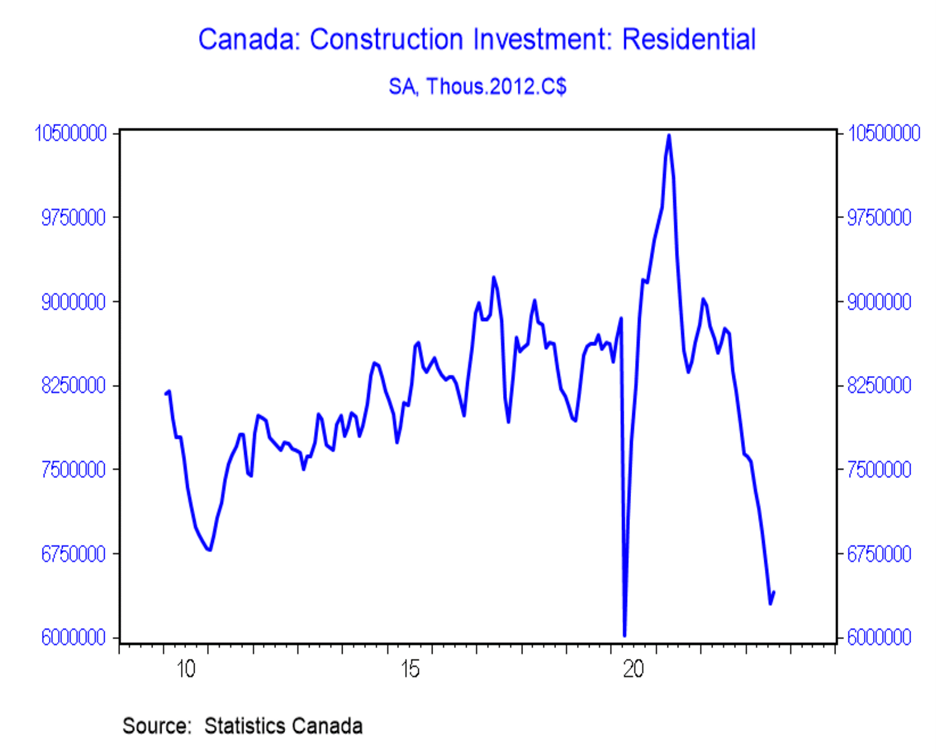
    Not surprising, BMO Capital Markets recently issued a statement warning its investors that residential construction investment is plummeting.

    They even went as far as commenting that, perhaps the government should try stopping the decline in new construction before promising to double it. Ouch.

    Quite simply, Canadian investors are putting a lot less money into building more houses.

    The bank notes that this is the worst annual decline since 2011.

    construction-investment

    So the solution is this… we need housing, badly!

    But those who are most effective at adding to the housing supply (builders, developers, investors) are not able/willing as the economics don’t make sense for them.

    Essentially, the gap between what it costs a builder/developer/investor, and what an end-user is can afford, is too large.

    To us, in the mid-to-short term, this means one of two things…

    1. Politicians allow things to play out naturally, and the already politically charged housing problem continues to get worse and worse, or
    2. governments will try to deal with the issue in the only way they know how, and that is to try and re-stimulate investor demand by enticing them to add to the housing supply (think… more money printing and lower interest rates).

    The BMO folks appear to be more confident that governments are embracing the investor-driven model.

    “Recent moves by the federal governments to lower borrowing costs for developers and reduce sales tax on the construction of rental units are helpful first steps.” – BMO Senior Economist Sal Guartieri

    Agree or disagree with this approach, that is up to you.

    But we too feel that this is the most likely outcome.

    And based on our conversations with the investor community, you can bet that they are ready and eager to get going.

    I’m not at all saying that we will see another 2021 run up in real estate prices…

    …but what I am saying is that it would have been really beneficial to have known ahead of time the impact that the 2020 pandemic response policies had on real estate values.

    Everyone’s situation is different… and how this applies to you may differ to how it applies to me.

    But if you already own real estate or desire to own real estate, then one way or another, you are affected by all of this.

    Feel free to reach out and have a conversation about how all this stuff may apply to your own situation.

    All The Best,
    Vince

  • The Mortgage Renewal Process

    The Mortgage Renewal Process

    If you’re a homeowner, your mortgage is likely one of the most significant financial commitments you’ll ever make. The mortgage renewal process is a critical milestone that deserves careful consideration. This article will guide you through the steps you should take when renewing your mortgage, helping you make informed decisions that align with your financial goals.

    Understanding Mortgage Renewal
    Mortgage renewal is the process of renegotiating the terms of your existing mortgage agreement once your current term expires. In Ontario, mortgage terms typically last anywhere from one to five years. When your term is up, you have the option to renew your mortgage with your current lender or explore other options in the market.

    Renewal is an excellent opportunity to reassess your financial situation, review your mortgage terms, and potentially take advantage of better interest rates or terms. It’s not an automatic process; you need to be proactive and take the necessary steps to secure a favorable renewal.

    Why Mortgage Renewal Matter
    Mortgage renewal can significantly impact your financial well-being. Here are a few reasons why it’s crucial to approach it with care:

    • Financial Stability: Your mortgage is likely your most substantial financial obligation. Renewing at a higher interest rate or unfavorable terms could strain your budget and affect your overall financial stability.
    • Savings Opportunity: A lower interest rate can lead to substantial savings over the life of your mortgage. Mortgage rates can fluctuate, so renewing at the right time can save you thousands of dollars.
    • Customization: Renewal allows you to customize your mortgage to better fit your current financial situation and goals. You can choose a different term, payment frequency, or even make additional lump-sum payments.
    • Switching Lenders: You’re not obligated to renew with your current lender. Exploring other lenders may result in more competitive rates and terms, potentially benefiting your financial situation.

    Steps to Take When Renewing Your Mortgage
    Now that you understand the importance of mortgage renewal, let’s delve into the steps you should take to ensure a smooth and beneficial process:

    1. Start Early
    Don’t wait until the last minute to initiate the renewal process. Start at least four to six months before your current mortgage term expires. This gives you ample time to evaluate your options, research rates, and make informed decisions.

    2. Review Your Current Mortgage
    Begin by thoroughly reviewing your current mortgage agreement. Take note of your interest rate, remaining balance, term length, and any specific terms or conditions. Understanding your existing mortgage terms is essential for making informed decisions during renewal.

    3. Assess Your Financial Situation
    Evaluate your financial goals, income, and expenses. Determine whether your circumstances have changed since you first obtained your mortgage. Consider factors like job stability, family size, and other financial commitments. This assessment will help you determine the type of mortgage that best suits your needs.

    4. Shop Around for Rates
    One of the most crucial steps in the mortgage renewal process is shopping around for competitive rates. Contact multiple lenders, including your current one, to inquire about their renewal offers. Compare interest rates, terms, and any additional benefits or incentives.

    5. Negotiate with Your Current Lender
    Once you’ve gathered renewal offers from different lenders, don’t hesitate to negotiate with your current lender. They may be willing to match or beat the offers you’ve received from other institutions to retain your business. Negotiation can potentially lead to more favorable terms and conditions.

    6. Consider Your Mortgage Term
    Choose a mortgage term that aligns with your financial goals. Shorter terms typically come with lower interest rates but higher monthly payments, while longer terms offer stability with fixed monthly payments but slightly higher interest rates. Consider whether you want a fixed or variable rate mortgage based on your risk tolerance.

    7. Think About Payment Frequency
    Select a payment frequency that suits your budget and financial habits. Options typically include monthly, bi-weekly, or weekly payments. Making more frequent payments can help you pay off your mortgage faster and save on interest.

    8. Review Additional Features
    Pay attention to any additional features offered with your mortgage, such as the ability to make lump-sum payments or increase your regular payments. These features can help you pay down your mortgage more quickly and save on interest costs.

    9. Seek Professional Advice
    Consider consulting a Mortgage Broker for guidance. They can help you navigate the renewal process, provide expert advice on your financial situation, and connect you with lenders offering the best terms to suit your needs.

    10. Lock in Your Rate
    Once you’ve chosen a lender and agreed on the terms, it’s essential to lock in your interest rate. Interest rates can fluctuate, so securing your rate ensures you won’t be affected by any potential increases before your renewal date.

    11. Complete the Renewal Process
    After finalizing your mortgage renewal agreement, your lender will provide you with the necessary documents to complete the process. Review these documents carefully and seek legal advice if needed. Once everything is in order, sign the renewal documents to formalize the agreement.

    Mortgage renewal in Ontario is a crucial financial decision that can significantly impact your long-term financial health. By following these steps and taking a proactive approach, you can make informed choices that align with your financial goals. Remember to start early, assess your financial situation, shop around for rates, and negotiate with your current lender to secure the best possible mortgage terms. With careful planning, you can ensure that your mortgage renewal process leads to a more secure financial future.


  • Canadian Real Estate Prices Will Continue to Go Up

    Canadian Real Estate Prices Will Continue to Go Up

    This is my family just before we broke ground on construction of our new family home — Winter 2022.

    Almost two years later (and many more grey hairs to show for it), we are just about completed the build, and gearing up to move in (finally!).

    Lots has happened over the last two years… especially in real estate and the financial system. One thing that has not changed — my decision to NOT sell our current family home.

    Those that know me, know that I preach about owning and holding good quality hard assets (even better if they are cashflow positive!).

    To me, there is still no better hard asset than a single-family home, in a good neighbourhood.

    When we purchased this home back in 2011, I told my wife that we will never sell this house.

    I would be lying if I said I haven’t been tempted to sell…

    ..especially during the run up in prices over the last few years…

    ..and even more so as it became very apparent that my construction budget for the new house was not worth the paper it was written on, lol (this is a story for another day).

    So why am I hanging on to it, you ask?

    Especially given all of the uncertainty in today’s crazy real estate market — I’ll tell you why..

    …in addition to the sentimental reasons at play (this was our first home together and our three kids were all born in this home).

    I remain steadfast in my belief that asset prices will continue to increase over the long term, and a good, cashflow positive single family home will be harder and harder to acquire.

    And here’s some reasons why I feel this way… check out these charts produced by my friends at Rock Star Real Estate…

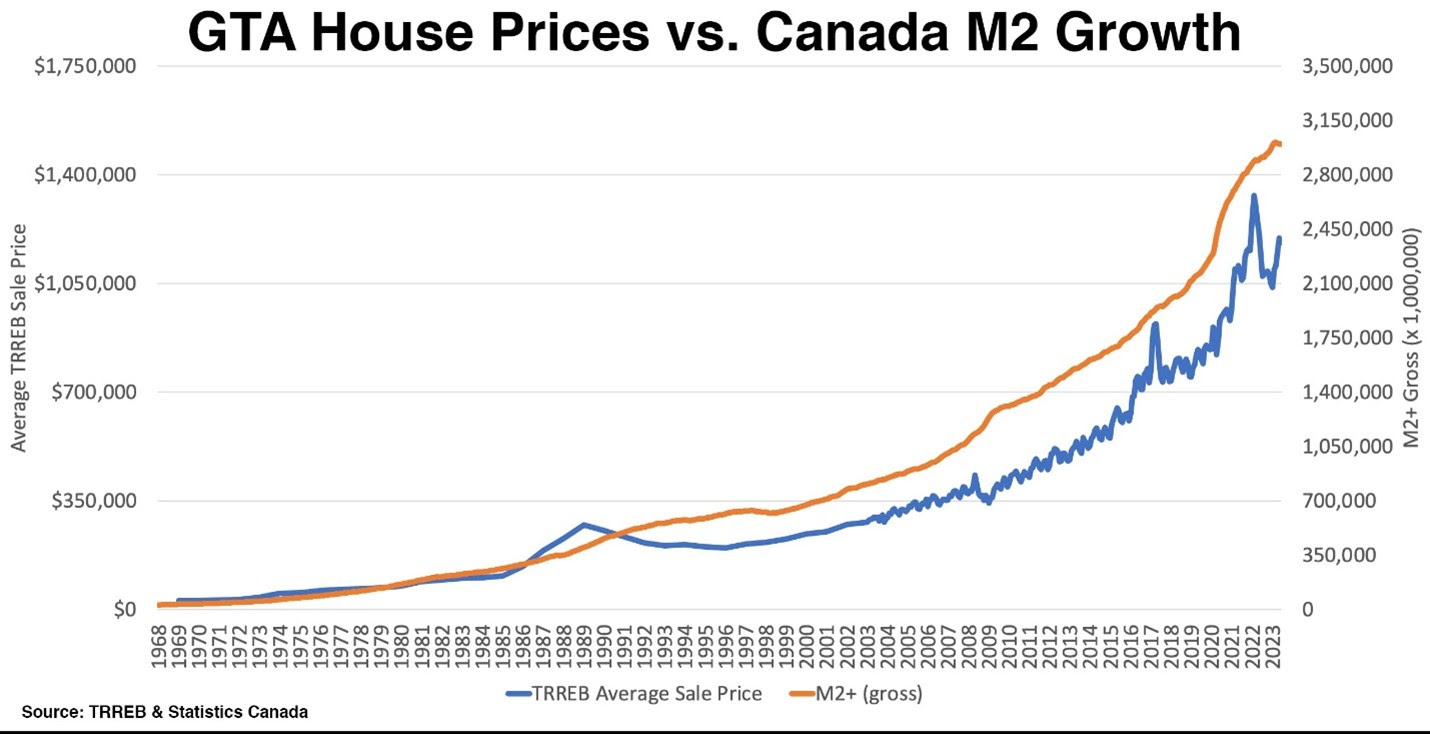
    gta house prices vs m2 growth

    Okay, so what are we to look at here, you ask… This is average price of a house in the GTA (between 1968 and 2023) versus the growth in the Canadian M2 Supply.

    What is M2? To simplify it, M2 is the amount of ‘new’ money being added to the economy. When you hear people talking about the government ‘printing money’ — this is what they are referring to.

    What this chart shows is that, when M2 goes up, so does real estate prices.

    Assuming we can agree that increased money supply translates to increased real estate prices, then the next question is… will M2 continue to increase?

    Again, looking at this chart… you will see that the M2 supply is always growing.

    Our Canadian Central Bankers (the people that watch over our financial system here in Canada), are really only a one trick pony — they can increase or decrease the money supply and/or interest rates.

    And when it comes to interest rates, historically, to protect the value of our currency we have always just copied the interest rate policy of the U.S. Federal Reserve (the Central Banker in the United States) — so if they increase/decrease interest rates, then we follow suit.

    So on that basis… controlling the money supply is the primary go to tool of our Central Bank.

    So what’s happening with the money supply right now?

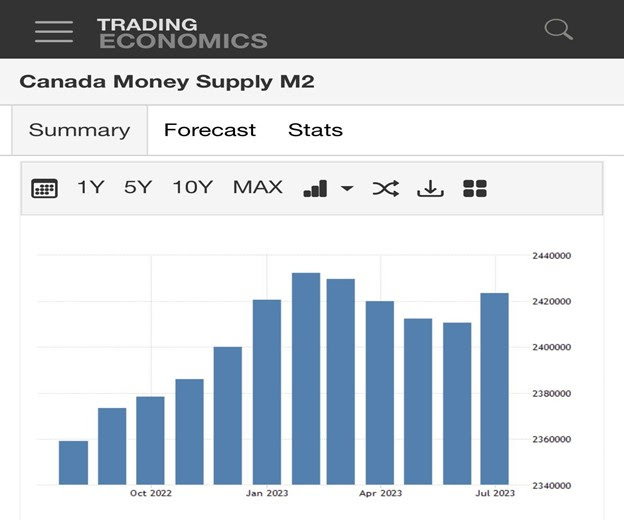
    Canada Money Supply M2

    According to this chart, M2 supply (i.e. ‘new’ money entering the economy) in Canada is going up again as of the last quarter! Despite the higher interest rates!

    Our interpretation — the high interest rates are finally starting to show their impact on the Canadian economy… and if they are going to continue to keep pace with the interest rate policy of the US (higher rates for longer), then to try to offset the drag on the economy caused by the high interest rates… they will continue to grow the money supply.

    Could this be why we haven’t seen real estate prices plummet, despite record pace interest rate hikes?

    What impact does this extra money in circulation have on real estate prices when interest rates inevitably come down at some point?

    In my simple mind (and I assure you… it is very simple), the formula is…

    Increased M2 = positive for real estate prices
    Lower interest rates = positive for real estate prices
    Increased M2 + Lower interest rates = real estate prices on steroids (think 2020-2022)

    So although everybody is focused on whether the Bank of Canada will hike, pause, or drop rates, in the short term… for those playing the long game… it’s all just noise.

    Long term, it’s hard to see a scenario where prices don’t continue to go up… And that’s without even addressing the other simple fundamentals like the supply and demand of houses (a topic for another day).

    As I always say… all we can do is try to provide ourselves with an information advantage… and based on the information currently at my disposal…

    …I’m betting on real estate prices to continue to go higher in the long term… and that’s why I’m going hang on to my current house, as long as I can.

    All the best,
    Vince Castagna

  • Mortgage Payment Difficulties?

    Mortgage Payment Difficulties?

    Homeownership is a dream for many Canadians, but it can sometimes turn into a financial challenge when mortgage payments become difficult to manage. Whether due to unexpected financial setbacks, job loss, or other unforeseen circumstances, struggling to meet mortgage obligations is a stressful experience. In Ontario, there are specific steps and resources available to help homeowners facing mortgage payment difficulties. This article will provide a comprehensive guide on how to navigate these challenging situations and work towards a solution that keeps your home secure.

    Assess Your Financial Situation
    The first step in addressing mortgage payment difficulties is to gain a clear understanding of your financial circumstances. Create a detailed budget that includes all your income sources and monthly expenses. This will help you identify areas where you can cut costs and allocate more funds toward your mortgage payments. Additionally, compile a list of all your debts, including credit card balances, personal loans, and any outstanding bills.

    Contact Your Mortgage Lender
    Open and honest communication with your mortgage lender is crucial when facing payment difficulties. In many cases, lenders may be willing to work with you to find a solution. Contact your lender as soon as you anticipate or experience difficulties in making payments. Explain your situation and be prepared to provide documentation that supports your claim, such as proof of income changes or medical bills.

    Payment Deferral
    In response to financial hardships caused by the COVID-19 pandemic, the Canadian government introduced mortgage relief programs, allowing homeowners to defer their mortgage payments for a specified period. These programs may still be in effect or have been extended. Speak with your lender to explore the possibility of payment deferral, which can provide temporary relief by postponing your mortgage payments.

    Loan Modification
    If your financial difficulties are expected to be long-term or if you’ve fallen behind on your mortgage payments, discuss the possibility of a loan modification with your lender. Loan modification may involve changing the terms of your mortgage, such as extending the loan term, reducing the interest rate, or adding the missed payments to the end of the loan. Keep in mind that this option may impact the total interest you pay over the life of the loan, but it can make your monthly payments more manageable.

    Seek Financial Counselling
    Non-profit credit counselling agencies can provide valuable assistance in managing your finances and navigating mortgage payment difficulties. These agencies can help you create a debt management plan, negotiate with creditors, and offer advice on budgeting and financial planning. In Ontario, reputable agencies like Credit Canada and the Credit Counselling Society can provide these services.

    Explore Government Assistance Programs
    The Canadian government offers various programs to assist homeowners facing financial hardship. The Canada Mortgage and Housing Corporation (CMHC) administers some of these programs. The Homeowner Mortgage Assistance Program (HOAP) is designed to help eligible homeowners in Ontario who are at risk of losing their homes due to unforeseen circumstances. HOAP provides temporary financial assistance to cover mortgage arrears and property tax arrears.

    Legal Advice & Mediation
    If your mortgage lender is uncooperative or if you face foreclosure, it may be advisable to seek legal counsel. Consult with a lawyer experienced in real estate and foreclosure matters to understand your rights and options. Legal experts can negotiate with your lender on your behalf, explore legal defenses, and help you explore alternative solutions.

    Mediation is another option to consider. Mediation involves a neutral third party who facilitates communication between you and your lender to find a mutually agreeable solution. The Financial Services Regulatory Authority of Ontario (FSRA) provides information on mediation services for homeowners facing foreclosure.

    Investigate Refinancing
    If you have built equity in your home and your credit is still relatively intact, consider refinancing your mortgage. Refinancing involves replacing your existing mortgage with a new one, often with more favorable terms. This can lower your monthly payments and provide you with extra funds to address your financial difficulties. However, refinancing may not be suitable for everyone, so it’s essential to evaluate the long-term implications before proceeding.

    Sell Your Property
    If all else fails and you cannot secure a workable solution to address your mortgage payment difficulties, selling your property may be the best course of action. While this can be a difficult decision, it can help you avoid foreclosure and protect your credit score. If you choose to sell, work with a real estate agent who specializes in distressed properties to expedite the process and maximize your home’s value.

    Avoid Scams and Predatory Lending
    When dealing with mortgage payment difficulties, it’s crucial to be wary of scams and predatory lending practices. Unfortunately, some individuals and organizations may take advantage of vulnerable homeowners. Be cautious of anyone offering “guaranteed” solutions that require upfront fees or seem too good to be true. Always verify the legitimacy of any organization or individual before seeking assistance.

    Facing mortgage payment difficulties is a challenging situation, but it’s essential to remember that there are options and resources available to help you navigate this difficult time. Early communication with your lender, exploring government assistance programs, and seeking professional advice can all contribute to finding a solution that allows you to keep your home and regain financial stability. By taking proactive steps and seeking assistance when needed, homeowners in Ontario can work towards a brighter financial future even in the face o

  • Preparing Your Home for the Winter Months

    Preparing Your Home for the Winter Months

    As the crisp winds of autumn descend upon us, homeowners must brace themselves for the inevitable chill of winter. Preparing your home for the winter season is not just about staying warm and cozy; it’s also about ensuring your property’s safety and energy efficiency during the colder months. In this guide, we will outline the essential steps that homeowners should take to get their homes ready for winter.

    1. Inspect & Maintain Your Heating System
    Before the winter season sets in, it’s crucial to ensure that your heating system is in optimal working condition. Start by scheduling a professional HVAC inspection and maintenance service. This should include cleaning or replacing air filters, checking for any leaks or blockages, and making any necessary repairs. A well-maintained heating system will not only keep your home warm but also operate more efficiently, saving you money on energy bills.

    2. Winterize Your Air Conditioner
    Your AC won’t be in use, but it still needs care. Clean the unit, remove leaves, twigs, and dirt. Cover the outdoor unit using a waterproof cover to protect it from snow and ice.

    3. Seal Drafts & Insulate Your Home
    Windsor’s winters can be bitterly cold, and keeping the warm air inside your home is essential. Begin by checking for drafts around windows, doors, and any other potential openings. Use weather-stripping and caulk to seal gaps and prevent cold air from entering your home. Additionally, consider adding or improving insulation in your attic and walls, as proper insulation helps retain heat and can significantly reduce energy costs.

    4. Check Your Home’s Foundation
    Prevent cold air from entering the house through the foundation. Inspect for cracks, seal any gaps to prevent drafts and potential pest entry. Clear away debris, remove leaves and other debris from the foundation to prevent moisture buildup.

    5. Clean & Inspect the Fireplace and Chimney
    If you have a fireplace or wood-burning stove, it’s crucial to ensure they are safe and ready for use during the winter. Have your chimney cleaned and inspected by a professional to remove any creosote buildup, which can pose a fire hazard. Check the damper for proper operation and make any necessary repairs. Stock up on firewood and ensure it’s properly seasoned for efficient burning.

    6. Prepare Your Plumbing
    Winters in Windsor can be cold enough to freeze pipes, potentially causing costly damage. To prevent this, follow these steps:

    • Insulate exposed pipes: Wrap pipes in insulation to keep them from freezing.
    • Disconnect hoses: Remove garden hoses from outdoor faucets and drain them. Shut off outdoor water valves.
    • Consider a pipe heating cable: For vulnerable areas, such as outdoor pipes, consider installing a pipe heating cable to prevent freezing.

    7. Roof & Gutter Maintenance
    Snow and ice can place a significant strain on your roof and gutters. Before winter arrives, inspect your roof for any loose or damaged shingles and have them repaired or replaced. Clear leaves and debris from gutters and downspouts to ensure proper drainage. Installing gutter guards can help prevent clogs and reduce the risk of ice dams.

    8. Winterize Your Lawn & Garden
    Preparing your lawn and garden for winter is not only about protecting your plants but also maintaining the overall appearance of your property. Follow these steps:

    • Trim trees and shrubs: Prune trees and shrubs to remove dead or overhanging branches that could be damaged by heavy snow or ice.
    • Clean up your garden: Remove dead plants and debris from your garden to prevent pests and disease.
    • Protect delicate plants: Cover delicate plants with burlap or other protective materials to shield them from harsh winter conditions.

    9. Snow Removal Equipment
    Ensure you have the necessary snow removal equipment on hand, including shovels, a snow blower, and ice melt. Be prepared to keep your driveway and walkways clear to prevent slips and falls. Proper snow removal is not only essential for safety but also for maintaining the integrity of your outdoor surfaces.

    10. Prepare for Power Outages
    Winters in Windsor can bring heavy snow and ice, which may lead to power outages. To prepare for this possibility, consider the following:

    • Invest in a generator: A backup generator can provide essential power during outages, keeping your home warm and allowing you to use essential appliances.
    • Stock up on essentials: Maintain a supply of non-perishable food, bottled water, flashlights, batteries, and blankets in case of an extended power outage.

    11. Emergency Kit
    It’s always wise to have an emergency kit on hand, especially during the winter months. Your kit should include:

    • Flashlights and batteries
    • A first-aid kit
    • Blankets and warm clothing
    • Non-perishable food and water
    • A battery-powered radio
    • Extra phone chargers
    • Essential medications

    12. Check Smoke & Carbon Monoxide Detectors
    Winter often involves increased use of heating appliances, which can pose a risk if not properly maintained. Ensure your smoke and carbon monoxide detectors are in good working condition and replace batteries as needed. Carbon monoxide is especially dangerous because it is odorless and can be deadly if undetected.

    Preparing your home for winter requires a combination of practical steps to keep your home warm, safe, and energy-efficient. By inspecting and maintaining your heating system, sealing drafts, preparing your plumbing, and taking care of your roof and gutters, you can minimize the potential challenges that winter may bring. Additionally, don’t forget to winterize your lawn and garden, invest in snow removal equipment, and assemble an emergency kit to be well-prepared for whatever the season may bring. With proper preparation, you can enjoy a cozy and secure winter season in your home.